



UCL Minds


About
Available on








Community
860 episodes

About the Lecture: A tapestry of cosmic events stretching over the past 13.8 billion years have shaped our existence in a vast universe. This lecture will explore how the computer simulations to study the cosmos have developed in tandem with more down-to-earth pursuits like weather forecasting. We will see how the resulting computer codes have unlocked our understanding of the universe, from galaxies and black holes to the essence of matter. And the lecture will conclude with a look at the multiverse and the contentious idea put forward by some philosophers and scientists that we may already be living inside a simulation, Matrix-style. The talk is based on the lecturer's critically-acclaimed book “The Universe in a Box”, published in 2023. About the Speaker Andrew Pontzen, Professor of Cosmology at UCL Andrew Pontzen is a professor of cosmology and author of the recent highly-acclaimed book The Universe In A Box. His award-winning research uses computer simulations to shed light on the cosmos. He has written for the Guardian, New Scientist, BBC Sky at Night and BBC Science Focus; appeared on BBC, Amazon Prime and Discovery Channel documentaries; and contributed to BBC radio programmes including Inside Science, CrowdScience and The Curious Cases of Rutherford & Fry.


About the Lecture: Understanding reproductive health is key for everyone, whether we want children or not. Since writing a book called Your Fertile Years, Professor Harper has been researching into all aspects of reproductive health education and heads the International Reproductive Health Education Collaboration who aim to deliver reproductive health education to everyone. She created a survey to ask teenagers around the world their attitudes and knowledge to reproductive health. So far data has been obtained from the UK, Belgium, Greece and Japan. And she asked UK teenage girls how they feel about having a period. She has also surveyed over 6000 women to ask their attitudes and knowledge of their periods and menopause. Through this research, resources have been created to help teachers and health professionals provide education and she is heading the development of the UK Menopause Education and Support programme, so that all women in the UK can understand what happens during menopause. About the Speaker Joyce Harper, Professor of Reproductive Science at UCL Joyce Harper is an award-winning educator, author, podcaster, academic, and scientist. She is Professor of Reproductive Science at University College London in the Institute for Women’s Health where she is Head of the Reproductive Science and Society Group. She has worked in the fields of fertility, genetics and reproductive science since 1987, written over 240 scientific papers and published three books. She is leading the development of a UK Menopause Education and Support Programme with support from key organizations. She is co-founder of the UK Fertility Education Initiative (www.fertilityed.uk) and founder of the International Reproductive Health Education Collaboration (www.eshre.eu/IRHEC). She is working with schools in the UK and globally to help deliver reproductive health education. Her latest book, Your Fertile Years, What you need to know to make informed choices, was published in 2021 by Sheldon Press. Her podcast is called Why Didn’t Anyone Tell Me This? Is available on all podcast channels. Further information – www.joyceharper.com Follow on X (formerly Twitter), Instagram, Tiktok and Linkedin - @ProfJoyceHarper
In part two of a two part medical special we focus on the question 'If I am good at Maths and Biology and I want to go into Neurosurgery and Science, do I have to start out as an ordinary doctor? I am also interested in Pathology, where do I start with this?' In this episode we focus on the second question and Dr. Shoba Poduval talks us through a career in Pathology. Date of episode recording: 2024-03-19T00:00:00Z Duration: 00:11:37 Language of episode: English Presenter: Roberta Livingston Guests: Dr Shoba Poduval Producer: Roberta Livingston and Emma Bryant
In part one of a two part medical special we focus on the question 'If I am good at Maths and Biology and I want to go into Neurosurgery and Science, do I have to start out as an ordinary doctor? I am also interested in Pathology, where do I start with this?' In this episode we focus on the first question and Dr. Shoba Poduval talks us through applying for medical school and how to pursue a career in Neurosurgery. Date of episode recording: 2024-03-19T00:00:00Z Duration: 00:11:37 Language of episode: English Presenter: Roberta Livingston Guests: Dr. Shoba Poduval Producer: Roberta Livingston and Emma Bryant
This week we’re looking at disputes between states and international investors. How are they resolved? And why should every one of us care about them? Date of episode recording: 2024-02-29T00:00:00Z Duration: 38:13 Language of episode: English (UK) Presenter: Prof Alan Renwick Guests: Lauge Poulsen Producer: Eleanor Kingwell-Banham
This week we’ll be examining online death threats and asking how online platforms ought to respond. Date of episode recording: 2024-02-22T00:00:00Z Duration: 31:27 Language of episode: English (UK) Presenter: Dr Emily McTernan Guests: Jeffrey Howard and Sarah Fisher Producer: Eleanor Kingwell-Banham
This week we ask: how should the European Union handle the political, social, and economic diversity amongst its member states – and what can it do about democratic backsliding? Date of episode recording: 2024-02-15T00:00:00Z Duration: 39:08 Language of episode: English Presenter: Dr Emily McTernan Guests: Richard Bellamy Producer: Eleanor Kingwell-Banham
Marking LGBT+ History Month, this week we’re looking at the battle for LGBT+ rights around the world. How great are the challenges facing rights campaigners today? And how could they be addressed? Date of episode recording: 2024-02-08T00:00:00Z Duration: 40:42 Language of episode: English Presenter: Prof Alan Renwick Guests: Phillip Ayoub Producer: Eleanor Kingwell-Banham
This week we’re looking at how parliaments question prime ministers. How does questioning work? And does it actually do any good? Date of episode recording: 2024-01-25T00:00:00Z Duration: 37:22 Language of episode: English Presenter: Prof Alan Renwick Guests: Ruxandra Serban Producer: Eleanor Kingwell-Banham
This week we’re looking at the politics of power-sharing in Northern Ireland. What is it? Why is it not currently working? And what is its future? Date of episode recording: 2024-01-11T00:00:00Z Duration: 40:31 Language of episode: English Presenter:Prof Alan Renwick Guests: Conor Kelly and Alan Whysall Producer: Eleanor Kingwell-Banham
Join hosts Doctor Xand van Tulleken and Dr Rochelle Burgess for Season 4, Episode 3 of Public Health Disrupted. "It's not our children who are disordered, it's the environment in which we're expecting them to operate." In this month’s episode, our experts explore the pressing issue of children's mental health in the UK. With one in five young individuals facing probable mental health disorders, the urgency for effective support systems is undeniable. Joining the conversation are Kate Silverton, renowned broadcaster turned qualified child therapist, and Professor Nicola Walshe, a proponent of climate change and sustainability education. Together, they dissect the challenges faced by schools and parents in supporting children's mental health and the innovative ways to foster well-being through nature and the arts. Kate Silverton shares her insights on the variability of mental health support in schools and the critical need for standardised, professionally trained mental health professionals on-site. She emphasises the importance of understanding the neuroscience behind children's behaviour and offers a sneak peak of some of the practical, science-backed strategies found in her latest book, ‘There’s still no such thing as naughty: parenting for the primary years’. Professor Nicola Walshe discusses her work with the UCL Centre for Climate Change and Sustainability Education, highlighting the transformative power of combining arts with nature to improve children's mental and emotional well-being. She presents compelling evidence from the Eco-Capabilities project, illustrating how such practices not only benefit the students but also reinvigorate teachers' passion for their profession. This episode is an impassioned call to disrupt the status quo of public health and education systems, advocating for a holistic approach that prioritises emotional well-being and connection to nature as the foundation for learning and growth. Public Health Disrupted with Rochelle Burgess and Xand Van Tulleken is produced by Annabelle Buckland at Decibelle Creative / @decibelle_creative For the transcript: https://www.ucl.ac.uk/health-of-public/transcript-redefining-classroom-nurturing-mental-health-through-nature-and-arts Date of episode recording: 2024-02-19T00:00:00Z Duration: 00:40:00 Language of episode: English Presenter: Xand van Tulleken; Rochelle Burgess Guests: Kate Silverton; Nicola Walshe Producer: Annabelle Buckland
For this podcast we are visited by Chris Layne (Nova Southeastern University) to discuss the topic 'Resilience in grief and bereavement'. The podcast is hosted by Shi-Hui Kau (UCL). This podcast covers: 1. What are the similarities between posttraumatic stress and grief reactions? 2. Does the circumstances or reasons of death affect the way a bereaved person grieves and build resilience? 3. What is multidimensional grief theory? 4. How can the average person help a close friend or loved one who is currently grieving? For the transcript: https://resiliencerg.wixsite.com/mysite/podcasts Date of episode recording: 2024-02-20T00:00:00Z Duration: 00:52:35 Language of episode: English Presenter: Shi-Hui Kau Guests: Chris Layne Producer: Jennifer McGowan
In this episode, we’re moving beyond the UK to explore global climate policy in the wake of COP28. Hosts Mark and Simon are joined by Pierre Cannet, the Global Head of Public Affairs and Policy at Client Earth, to discuss how the law can be used to create change. More about Client Earth: https://www.clientearth.org/ For more information and to access the transcript: https://www.ucl.ac.uk/climate-change/podcasts-videos/generation-one-climate-podcast Sign up to our climate newsletter here: https://r1.dotdigital-pages.com/p/6T06-7DL/subscribe-to-ucl-climate-hubs-newsletters Date of episode recording: 16th February 2024 Duration: 27.12 minutes Language of episode: English Presenter: Mark Maslin and Simon Chin-Yee Guests: Pierre Cannet, Global Head of Public Affairs and Policy at Client Earth Producer: Adam Batstone
In this episode, we are hosting Professor Maria Todorova from the University of Illinois Urbana-Champaign to revisit her illuminating book 'Imagining The Balkans.' Professor Todorova specializes in Eastern Europe, particularly the Balkans in the modern period, focusing on historical demography, nationalism, socialism, and post-communism. Her work has had a major influence on the study of the Balkans and Orientalism as interconnected subjects and project. Date of episode recording: 2023-07-18T00:00:00Z Duration: 00:42:25 Language of episode: English Presenter: Dr. Sertaç Sehlikoglu; Meryem Zișan Köker; Hazal Aydın. Guests: Professor Maria Todorova Producer: Dr. Sertaç Sehlikoglu; Meryem Zișan Köker; Hazal Aydın.
Hosted by Olivia Moir, this very special episode discusses prenatal therapy with Prof Anna David, Director of the Institute for Women's Health here at UCL. Today we cover the basics of what the field of prenatal therapy is about, discussing the general lack of prenatal therapy in clinic and some of the factors behind why this is. We talk about the importance of conducting research to advance clinical practise in this field, supporting mums and the new generations to come. For more information and to access the transcript: www.ucl.ac.uk/womens-health/it-all-starts-here-ega-ifwh-institute-womens-health-podcast Date of episode recording: 2023-12-04 Duration: 36:15 Language of episode: English Presenter: Olivia Moir Guests: Prof Anna David Producer: Olivia Moir, UCL Changemakers
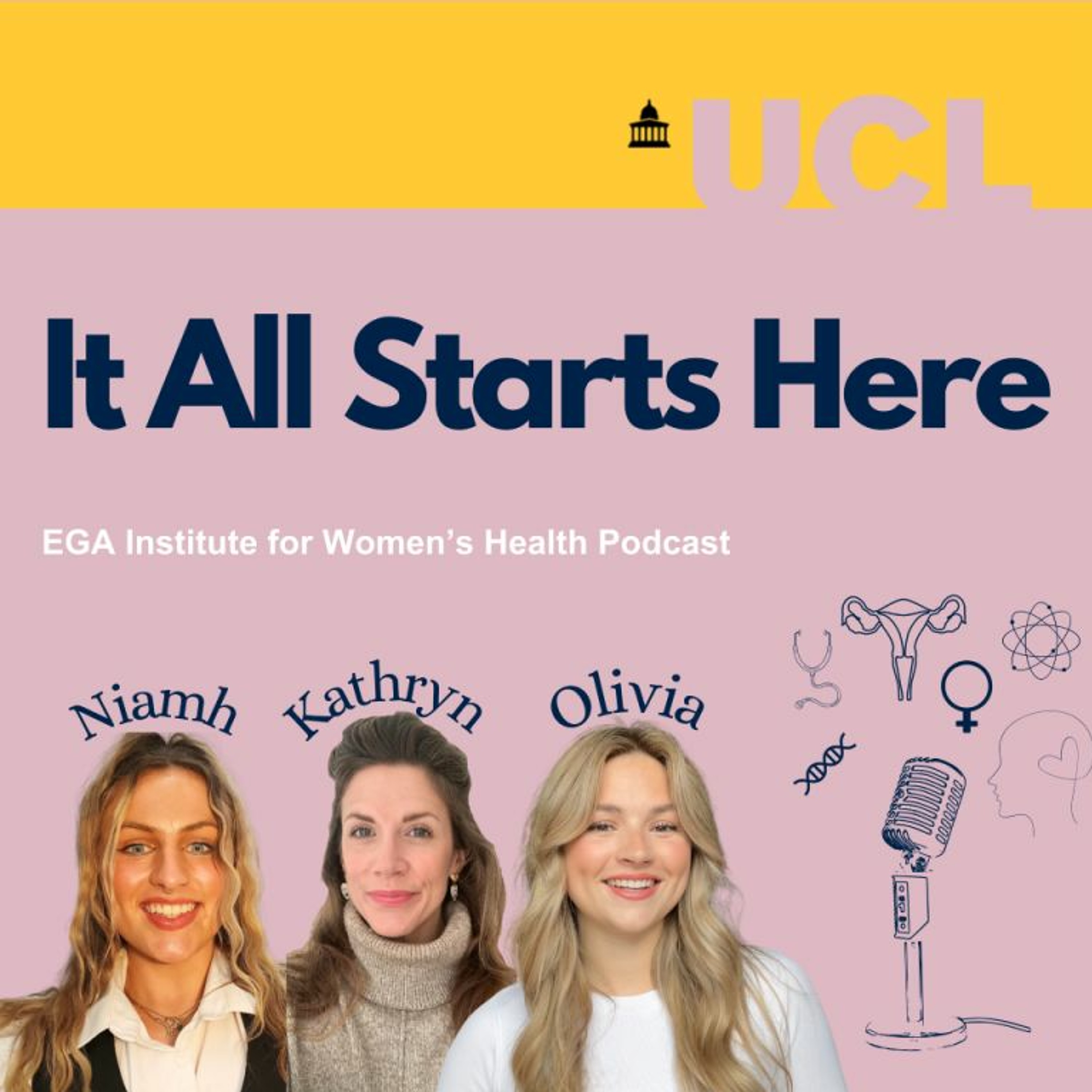
We are back for season 2 of It All Starts Here! Listen in as your longtime host Olivia Moir introduces you to our new hosts joining us this season, Kathryn Hunwick and Niamh Kenny. Kathryn is a a long-time educator, therapist and yogi, who’s all about helping women and people assigned female at birth (AFAB) to understand and support themselves holistically: body, mind and spirit. She is currently completing her masters in women's health at UCL to further her work. Niamh has always been extremely passionate about science and in particular menstrual health. She completed her bachelors in Molecular Medicine in Dublin and is currently pursuing a masters in women’s health here at UCL. This season, our mission remains the same: to bring awareness to critical topics in the fields of reproductive science and women's health, that are often pushed to the sidelines of conversation. We will also be shining a spotlight on the social aspects that shape these fields. From societal stigmas to cultural influences, we'll dive into the intersectionality of reproductive science and women’s health uncovering the layers of complexity that often go unnoticed. On top of this, we will be branching out and bringing in guests from various institutions around the UK. Tune in to learn more, we are so excited to guide you through another season of learning and communicating about reproductive science and women's health! Follow us on instagram @itallstartsherepodcastucl Date of episode recording: 2024-02-28T00:00:00Z Duration: 00:05:52 Language of episode: English Presenter: Olivia Moir, Kathryn Hunwick, Niamh Kenny Guests: N/A Producer: Olivia Moir, UCL changemakers
Celebrate International Women's Day with a special first episode of the new series of Life of PIE! Onya, your host, delves into the complex world of women's health alongside Kris Teow, an MSc PIE alum from the 2022-23 cohort. Kris shares findings from her qualitative study on the experiences of Malaysian corporate women, shedding light on the diverse ways women's health is perceived and managed globally. From the cultural construction of women's bodies to the stigma surrounding menstruation and menopause, the conversation explores the nuanced factors that shape women's health. Join them as they navigate cultural nuances and societal expectations and raise crucial questions. How do cultural norms shape women's health? What challenges do women face in different corners of the world? Join this eye-opening episode to unravel the complexities of women's health on a global scale, as Onya and Kris invite you to explore, question, and advocate for a more inclusive approach to women's well-being. More about Kris Teow: Kris is highly passionate about women's health as well as equality, diversity and inclusion (EDI) issues, Kristina is currently in the Partnerships team of The Forward Institute, an organisation focused on strengthening leadership for positive impact. Prior to this, she'd advised early-stage start-ups at UCL's enterprise incubator, the Hatchery, and earlier on, led the people and culture team at a Series A healthtech in Southeast Asia. She started her career in a global leadership advisory firm, working with large technology companies across APAC. Outside of work, she enjoys being an amateur yogi and swimming at whichever pool she can find." You can find out more about Kris and connect with her on LinkedIn. Production: The Life of PIE podcast is produced by Juan Manuel Fournier Castillo, an MSc PIE alumni and Creative strategist. All voice actors are MSc PIE alumni and we are grateful to the team for taking the time to co-create this season. Date of episode recording: 2024-03-04T00:00:00Z Duration: 00:35:32 Language of episode: English Presenter: Dr Onya Idoko Guests: Kristina Teow Producer: Juan Manuel Fournier Castillo
We are back with the second series of the Life of PIE podcast. Dr Onya Idoko lets us know what we can expect from this season. Date of episode recording: 2024-03-04T00:00:00Z Duration: 00:02:28 Language of episode: English Presenter: Dr Onya Idoko; Juan Manuel Castillo Producer: Juan Manuel Castillo
Introducing episode 3 of season four! Our hosts Mark and Simon continue this series with a discussion on the fallout from COP28 for the UK, and what needs to be done on a national, governmental and local level. Joining them are our guests Ian Townsend (ONS Climate Lead), Robbie Macpherson, (APPG lead at Uplift), Annabel Rice (Political Advisor at Green Alliance) and Deputy Mayor for Environment and Energy at Greater London Authority, Shirley Rodrigues, to talk national feeling and climate policy. For more information and to access the transcript: https://www.ucl.ac.uk/climate-change/podcasts-videos/generation-one-climate-podcast Sign up to our climate newsletter here: https://r1.dotdigital-pages.com/p/6T06-7DL/subscribe-to-ucl-climate-hubs-newsletters References ONS release calendar: https://www.ons.gov.uk/releasecalendar/ Key ONS environmental releases: https://www.ons.gov.uk/economy/environmentalaccounts Public opinions and social trends, Great Britain Statistical bulletins: https://www.ons.gov.uk/peoplepopulationandcommunity/wellbeing/bulletins/publicopinionsandsocialtrendsgreatbritain/previousReleases Business insights and impact on the economy bulletins: https://www.ons.gov.uk/businessindustryandtrade/business/businessservices/bulletins/businessinsightsandimpactontheukeconomy/previousReleases Date of episode recording: 14th and 23rd February 2024 Duration: 27 mins, 14 secs Language of episode: English Presenter: Mark Maslin and Simon Chin-Yee Guests: Ian Townsend, ONS, Climate Lead Annabel Rice, Political Adviser at Green Alliance (and UCL alum) Robbie MacPherson, Political and Climate Change APPG Lead, Uplift Shirley Rodrigues, Deputy Mayor, Environment and Energy at Greater London Authority Producer: Adam Batstone
We are most likely to think about environmental data as sets of facts, but have you thought of it as having a social life? In this episode, we explore how those who collect and prepare environmental data may not necessarily be the ones to use or benefit from it: Dr Tone Walford and Dr Cecilia Chavana-Bryant draw on their experiences of collecting data across the Amazon in Brazil, French Guiana and Peru, and more recently in Hampstead Heath in London, the UK, to consider more collaborative and equitable forms of environmental data. We discuss how bringing together anthropologists, artists, forest ecologists, remote sensing specialists, and the UK’s Ancient Tree Forum, is helping to frame alternative modes of collecting, accessing, and sharing environmental data. Tone Walford is a Lecturer in Digital Anthropology, based in UCL’s Anthropology Department. Their work explores the new forms of data politics that underpin current efforts in international observational science to measure, archive, and manage the Earth. Cecilia Chavana-Bryant is a forest ecologist and a National Centre for Earth Observation Postdoctoral Research Fellow, based in UCL’s Geography Department. Her work broadly focuses on the ecology and function of temperate and tropical forests canopies. For the podcast transcript, details of our other podcasts and activities visit: http://tinyurl.com/mubmxu4n Date of episode recording: 2024-01-25T00:00:00Z Duration: 00:32:32 Language of episode: English Presenter: Lili Golmohammadi Guests: Tone Walford, Cecilia Chavana-Bryant Producer: Matt Aucott, Cerys Bradley
E-scooters provoke a 'Marmite' love or hate response in many of us. Still being piloted across UK cities, they straddle an uncertain legislative space, with concerns around safety not far from the headlines. Yet there are other important questions raised by this still-emergent form of transport. In this episode, we speak with Dr Daniel Oviedo about the multifaceted dimensions of transport-related social exclusion: from affordability, to fear, discrimination and more. We discuss the conditions that may allow or prohibit people from using E-scooters – a form of transport important to social development, connection, and Daniel argues wellbeing. We explore how working with researchers from sociology, behaviour change, sustainable transport and industrial engineering – and various stakeholders with local authorities, TFL, and Innovate UK, helped to conceptualise a more inclusive policy approach for E-scooters. Daniel Oviedo is an Associate Professor at UCL’s Bartlett Development and Planning Unit. He specialises in the social, economic, and spatial analysis of inequalities related to urban transport and policy evaluation, with projects situated across Latin America, Africa, and Asia, as well as here in the UK. For the podcast transcript, details of our other podcasts and activities visit: http://tinyurl.com/mubmxu4n Date of episode recording: 2024-01-25T00:00:00Z Duration: 00:25:28 Language of episode: English Presenter: Lili Golmohammadi Guests: Daniel Oviedo Producer: Matt Aucott, Cerys Bradley
In this episode, UCL’s Professor Jessica Ringrose shares her research on unsolicited sexual images on Snapchat, a social media platform which plays a central role in the lives of many teens. We discuss how this work uncovered high rates of non-consensual image sharing and led to the establishment of cyber flashing as a new criminal offence in the UK’s 2023 Online Safety Bill. We also explore how collaborating with young people, crime scientists, sex education charities, and policy makers, and the use of participatory arts-based methods, were key to uncovering children’s experiences of social media and achieving more equity and social justice in their lives. Jessica Ringrose is Professor of the Sociology of Gender and Education at UCL’s Institute of Education. She is a co-director of the UCL Centre for Sociology of Education and Equity and runs the Feminist Educational Engagement Lab with her doctoral students. She also co-runs the ‘Post-digital Intimacies’ research network, which looks at experiences in social media. For the podcast transcript, details of our other podcasts and activities visit: http://tinyurl.com/mubmxu4n Date of episode recording: 2023-10-10T00:00:00Z Duration: 00:23:31 Language of episode: English Presenter: Lili Golmohammadi Guests: Jessica Ringrose Producer: Matt Aucott, Cerys Bradley
The practical challenges of surviving harsh environments and limited resources in outer space have long been a focus of space research. But how might asking questions about living differently in space help us meet the challenges of living differently on earth? In this episode, we explore this with Dr Aaron Parkhurst as he discusses his multidisciplinary approach to studying ‘off-world living’. From Martian homes to exercise trampolines and funeral practices, we discuss the benefits of bringing together researchers from anthropology, architecture, art, design, cardiovascular science, molecular biology, psychiatry, and sustainable construction to open thinking about living well and the need, not only to survive, but to thrive. Aaron Parkhurst is an Associate Professor in medical anthropology at UCL. His work combines interests in science and genetics, cyborgs, the body and technology, and immigration, to address the complex challenge of how we might live differently on earth and beyond. For the podcast transcript, details of our other podcasts and activities visit: http://tinyurl.com/mubmxu4n Date of episode recording: 2023-10-19T00:00:00Z Duration: 00:24:45 Language of episode: English Presenter: Lili Golmohammadi Guests: Aaron Parkhurst Producer: Matt Aucott, Cerys Bradley
What do we mean when we talk about collaborative social science? Why is collaborative research useful? What are the standout themes of the collaborative projects featured in this second season of Together We Create? In this episode, we discuss these questions and more with Professor Carey Jewitt, Chair of UCL's Collaborative Social Science Domain. Carey Jewitt is Professor of Technology and Learning at the UCL Knowledge Lab, based in the Department of Culture, Communication and Media at the Institute of Education. She brings her interdisciplinary training from fine art and media, sociology, and multimodal discourse to research how the use of digital technologies shapes people’s interaction, communication, and learning in a variety of contexts. For the podcast transcript, details of our other podcasts and activities visit: http://tinyurl.com/mubmxu4n Date of episode recording: 2024-02-16T00:00:00Z Duration: 00:19:47 Language of episode: English Presenter: Lili Golmohammadi Guests: Carey Jewitt Producer: Matt Aucott, Cerys Bradley
This week we ask "how can we improve public services?" In particular, what are the structures and management strategies that best enable effective service delivery? Date of episode recording: 2023-12-14T00:00:00Z Duration: 36:08 Language of episode: English (UK) Presenter: Prof Alan Renwick Guests: Marc Esteve Producer: Eleanor Kingwell-Banham Transcript link: https://ucl-uncovering-politics.simplecast.com/episodes/improving-public-services/transcript
This week, we’re looking at how Russian leaders talk about sovereignty. In particular, how do their ideas about sovereignty help them rationalise war in Ukraine? Date of episode recording: 2023-12-07T00:00:00Z Duration: 34:46 Language of episode: English (UK) Presenter: Prof Alan Renwick Guests: Kalina Zhekova Producer: Eleanor Kingwell-Banham Transcript link: https://ucl-uncovering-politics.simplecast.com/episodes/russian-discourses-of-sovereignty/transcript
This week we’re discussing the politics of climate change and loss and damage policy, ahead of the upcoming COP28 conference. Date of episode recording: 2023-11-23T00:00:00Z Duration: 39:39 Language of episode: English Presenter: Emily McTernan Guests: Lisa Vanhala Producer: Eleanor Kingwell-Banham Transcript link: https://ucl-uncovering-politics.simplecast.com/episodes/climate-change-loss-and-damage/transcript
This week we’re looking at the role of historical research in political science. What’s it good for, and how’s it best done? Date of episode recording: 2023-11-30T00:00:00Z Duration: 33:56 Language of episode: English Presenter:Prof Alan Renwick Guests: Sam Erkiletian and Zeynep Bulutgil Producer: Eleanor Kingwell-Banham
This episode focuses on the recent emergent issues in Gaza, delving into the unfolding events and their broader impact, especially within the Global South. Date of episode recording: 2023-11-24T00:00:00Z Duration: 01:01:07 Language of episode: English Presenter: Dr. Mezna Qato; Dr. Sertac Sehlikoglu Guests: Dr. Goldie Asuri; Dr. Saada Toor; Dr. Sanaa Alimia Producer: Meryem Zisan Koker; Hazal Aydin
About the Lecture: The extent to which a face appears alive or lifeless has long been a topic in psychology, with the idea that more humanlike-looking faces achieve greater familiarity until a point is reached at which subtle imperfections give a sensation of strangeness – the uncanny valley effect. The uncanny valley effect term describes the sense of discomfort or unease we experience when we encounter a robot with certain human-like characteristics. With rapid advances in technology, AI-generated faces are now widely available and are being used for both helpful and criminal purposes, from finding missing children to transmitting political misinformation via fake social media accounts. In this talk, Dr Krumhuber will give a brief historical perspective on how we have overcome the uncanny valley with AI faces that are now indistinguishable from human faces. Also, Dr Krumhuber will present her recent work which found that White AI faces are judged as human more often than actual human faces—a phenomenon we term AI hyperrealism. About the Speaker Eva Krumhuber is associate professor in the Department of Experimental Psychology at University College London. Much of her work is concerned with the empirical investigation of the socio-cognitive and affective processes in human perception and behaviour. This includes research on facial expressions, especially morphological and dynamic features and their role in emotion interpretation. More recently, she started exploring commonalities and differences in human and machine classification of emotions, with a particular focus on how various elicitation methods (i.e., posed, spontaneous, naturalistic) influence recognition accuracy. She has published widely within the field of psychology and computer science.
