



Bhagavat Gita For Happiness's podcast


About
Available on








Community
100 episodes
In the 30th verse of chapter 3 of Bhagavad Gita for happiness, Lord Krishna expands on a topic and then finally presents the summary. He talks about the consciousness of dedicating all actions to God. It requires forsaking rights to proprietorship. It further emphasises on renouncing all desire for personal gain and worldly goods.

Lalwani talks about individuals who are deluded by the operation of the guṇas become attached to the results of their actions in the 29th verse of chapter 3 of Bhagavad Gita for happiness. He further explains that according to Lord Krishna, it is the wise who understand these truths. They are the ones who should not get unsettled by the ignorant.

In the 28th verse of chapter 3 of Bhagavad Gita for happiness, Lalwani talks about how people who are bewildered by the ego tend to misidentify themselves with the body and think of themselves the doers. He explains about the knowers of the truth who are free from bodily identifications. They discern their spiritual identity distinct from the corporeal body.

Lalwani talks about how humans do not direct humans' natural phenomena in the 27th verse of chapter 3 of Bhagavad Gita for happiness. Lord Krishna explains that the soul falsely identifies itself with the body more than the often unforgiving ego. As a result, the soul is held responsible for the actions of the mind-body mechanism.
In the 26th verse of chapter 3 of Bhagavad Gita for happiness, Lord Krishna urges wise people not to perform any actions or make any utterances that can cause ignorance toward downfall. Lalwani also explains by saying that the ignorant should not be asked to abandon duties when given superior instructions as they are not qualified to understand it.
In the 25th verse of chapter 3 of Bhagavad Gita for happiness, Lalwani uses the expression saktāḥ avidvānsaḥ has been used for people who are as yet in bodily consciousness and hence attached to worldly pleasures. He explains how firm faith in Vedic duties and rituals' performance can bring material rewards individual desires.
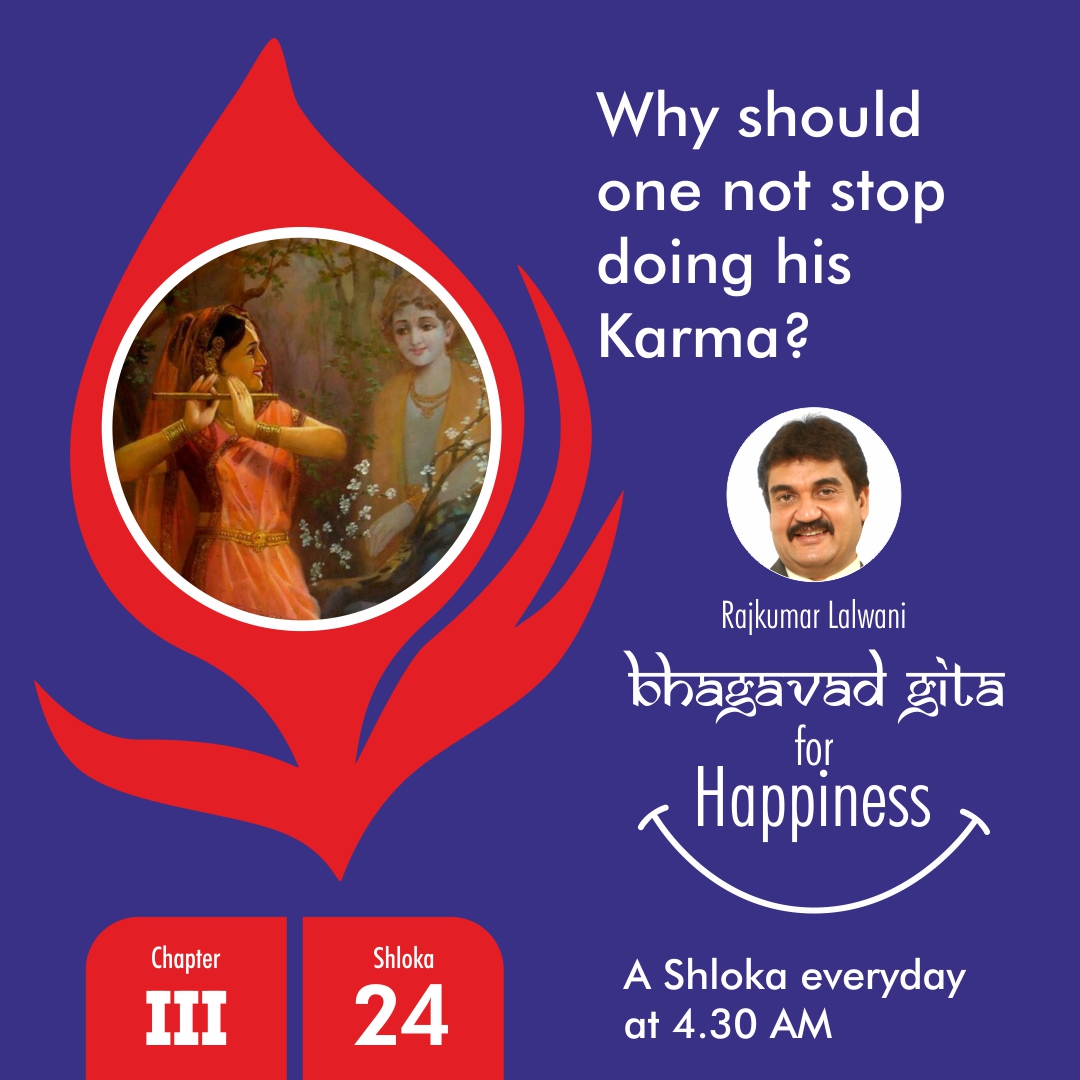
Lalwani talks about how Krishna conducted himself in all ways and manners, appropriate for his position in society, as a member of the royal warrior class in the 24th verse of chapter 3 of Bhagavad Gita for happiness. Lord Krishna explains that for the benefit of the entire human race and the world's welfare, Arjuna has to perform his warrior duties.
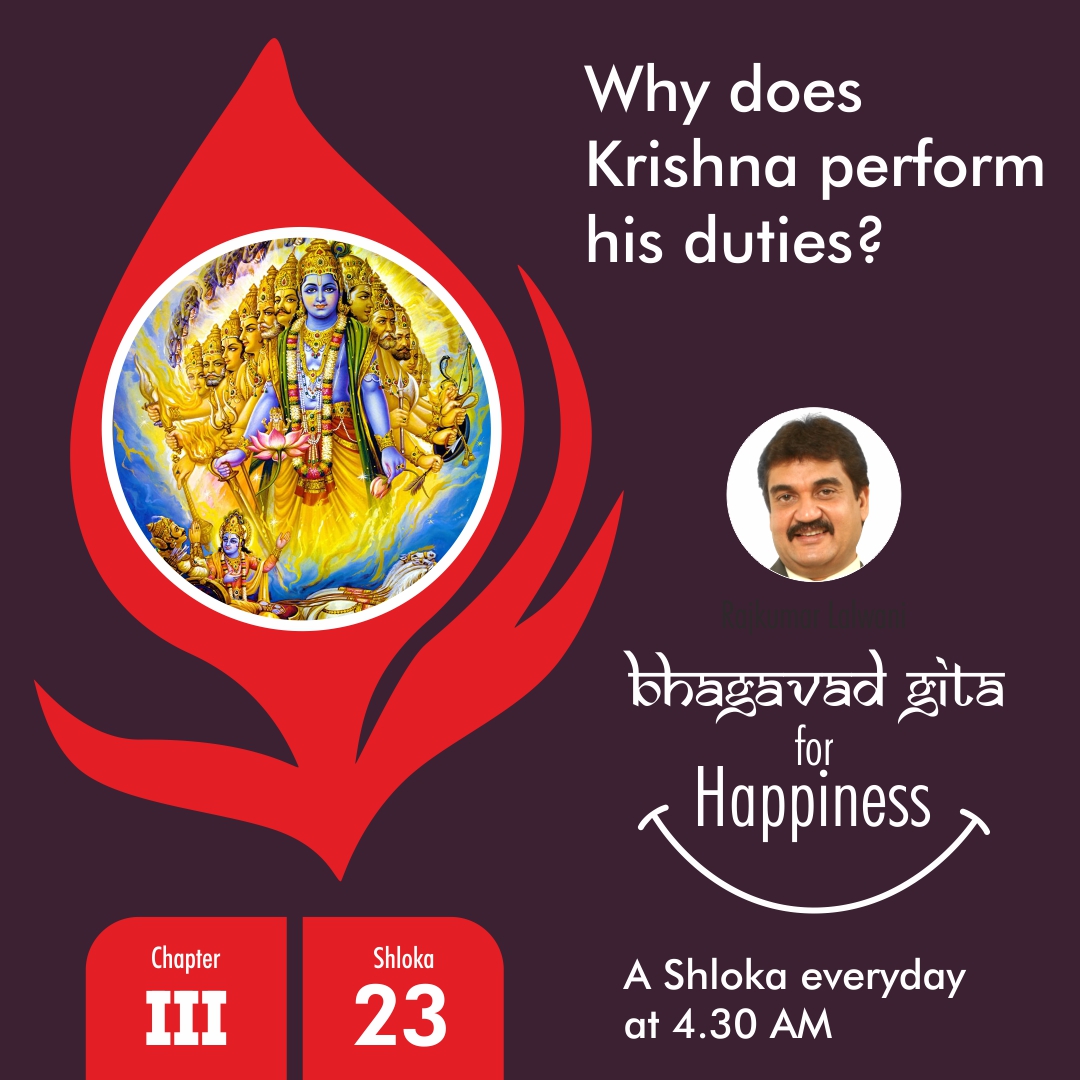
In the 23rd verse of chapter 3 of Bhagavad Gita for happiness, Lalwani talks about how Lord Krishna emerged on earth as a human being and took on various duties. He further explains if Krishna had not performed prescribed Vedic activities, many lesser personalities would follow in his footsteps, thinking that violating them was the standard practice.
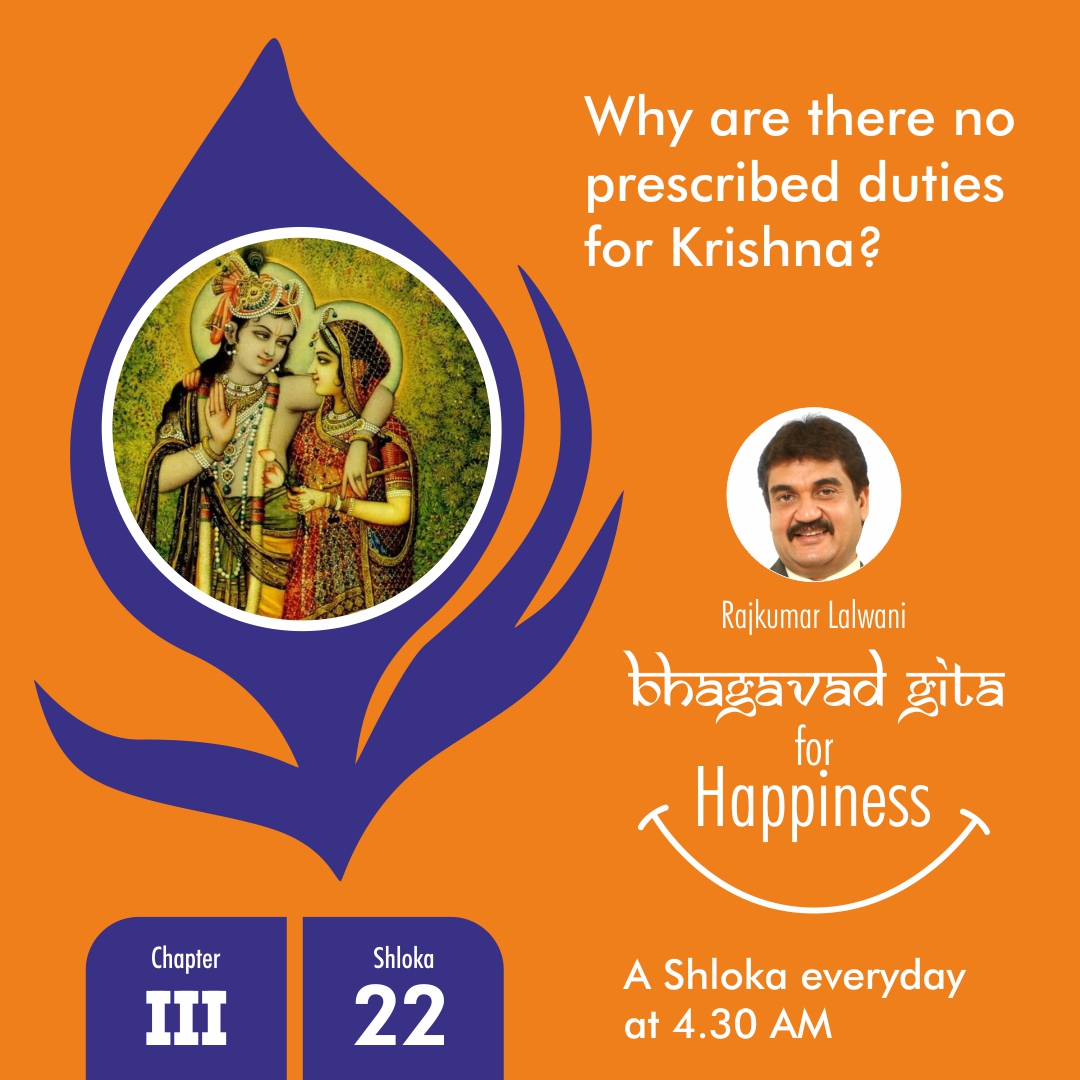
Lalwani talks about why Krishna has no duty to perform in the universe, yet he works for others' welfare in the 22nd verse of chapter 3 of Bhagavad Gita for happiness. Lord Krishna explains to Arjuna that bliss is one of God's energies, and he alone possesses it to an infinite extent. Though he is complete in himself, there is no need for anything outside of himself - but he accomplishes welfare through this work.
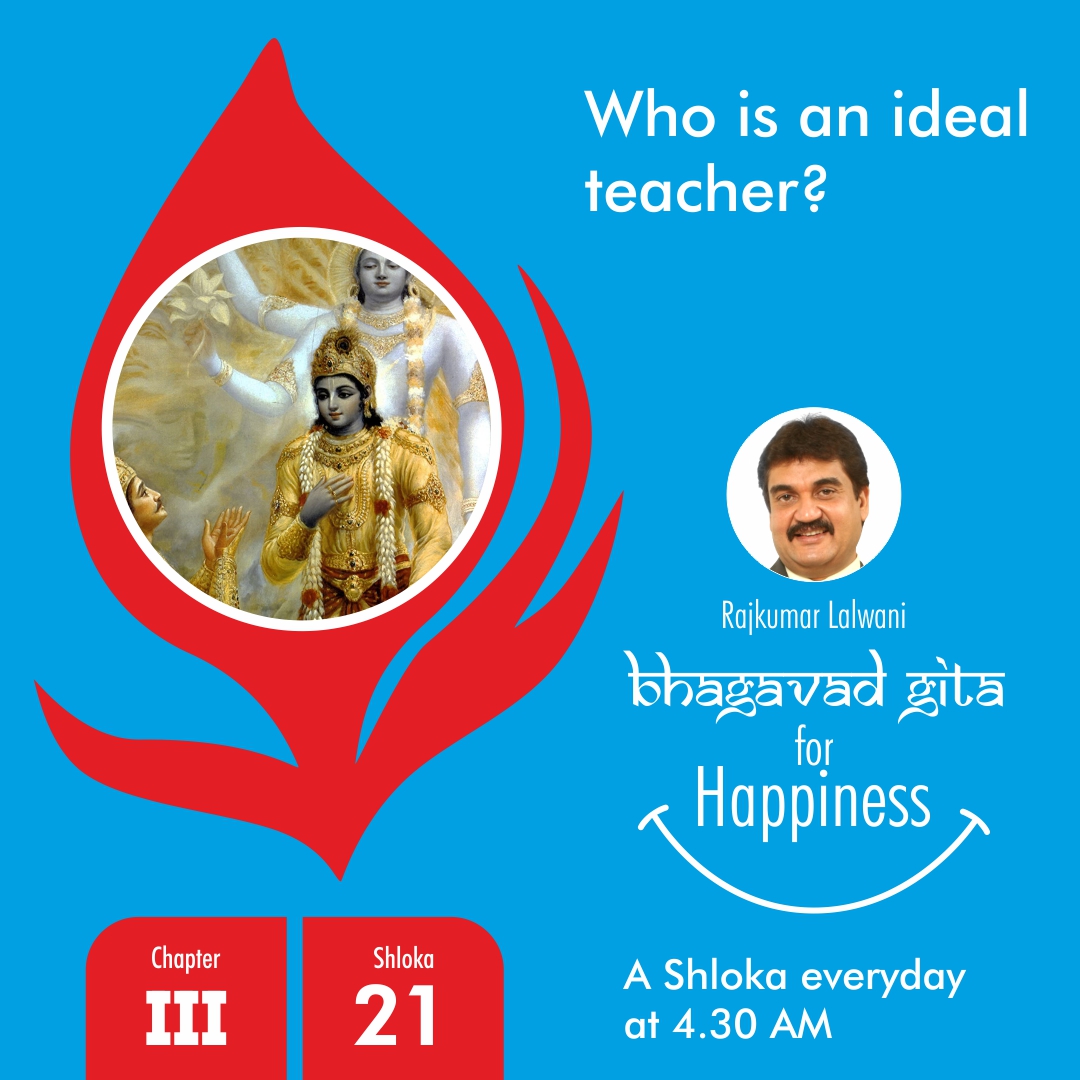
In the 21st verse of chapter 3 of Bhagavad Gita for happiness, Lalwani talks about how the leaders of our time have a moral responsibility to set lofty examples for inspiring the rest of the population by their words, deeds, and character. Krishna explains that great personalities should always act in an exemplary manner to set the world's standard.
In the 20th verse of chapter 3 of Bhagavad Gita for happiness, Lalwani talks about how humanity is inspired by the ideals that they see in the lives of great people. According to him, great leaders and personalities should act in an exemplary manner to set the standard for the world. She further suggests that Arjun should practice karma yoga and gives his own example to illustrate the above point.
Lalwani talks about reaching the transcendental platform to perform their prescribed duties in the 19th verse of chapter 3 of Bhagavad Gita for happiness. Krishna tells Arjuna that individuals who have not yet reached the transcendental platform to perform their prescribed duties. Krishan urges him to be a karma yogi, and not take karma sanyās. The reasons for the same are explained in later verses.

In the 18th verse of chapter 3 of Bhagavad Gita for happiness, Lalwani self-realized personalities are situated on the transcendental platform of the soul. Their every activity is transcendental. He further gets into the details of how one has to distinguish between karma and bhakti. Lord Krishna explains that both of these options exist for the self-realized sages.
Lalwani talks about how only those who have given up desires for external objects can rejoice and be satisfied in the self in the 17th verse of chapter 3 of Bhagavad Gita for happiness. Lord Krishna talks about karma (duties) prescribed for the materially conditioned souls are no longer applicable to such illumined souls.

In the 16th verse of chapter 2 of Bhagavad Gita for happiness, Lalwani talks about chakra or cycle of life. He explains how it impacts every form of living beings on the face of the planet. He discusses the wheel of nature has been set up by God for disciplining, training, and elevating all living beings of varying levels of consciousness.
In the 15th verse of chapter 2 of Bhagavad Gita for happiness, Lalwani says that duties for human beings are described in the Vedas, and the Vedas are manifested by God himself. Lord Krishna adds that Vedas guide humans to regulate their activities. If any task is not in tandem with the same, it is called sin or vikarma. He also explains about Yagna Purusa.
Lalwani talks about how living beings subsist on food, and rains produce food in the 14th verse of chapter 3 of Bhagavad Gita for happiness. Lord Krishna talks about the gifts of nature, mostly rain. Without rain, there can be no food grown. And this rain happens only after performing yagnas, which is based on sacrifice and devotion.

In the 13th verse of chapter 3 of Bhagavad Gita for happiness, Lalwani says that spiritually-minded people who eat food that is first offered in sacrifice, are released from all kinds of sin. The food which is leftover after offering it to God — or the prasad — are the ones who are relieved from these sins. Krishna adds that eating prasad releases one from sin, while those who eat food without offering commit sin.
Lalwani talks about how gods provide rain, wind, crops, vegetation, minerals, fertile soil, etc., to humans in the 12th verse of chapter 3 of Bhagavad Gita for happiness. Lord Krishna says that individuals who savor the gifts of nature without appreciating them or offering them to God first are nothing short of thieves. He further elaborates on the concept.
In the 11th verse of chapter 3 of Bhagavad Gita for happiness, Lalwani says that the celestial gods, or devatas, are in charge of the administration of the universe. These gods occupy specific posts in the affairs of running the world. Humans performing yagnas pleases the gods, and this will eventually lead to prosperity for everyone. He further elaborates how.
Lalwani talks about how all elements of nature are integral parts of the system of God’s creation in the 10th verse of chapter 3 of Bhagavad Gita for happiness. Lord Krishna talks about the beginning of the world or the universe. He talks about how Vishnu or Prajapathi sent four generations of men and demi-gods and blessed them to perform a yagna, which will deliver them all desirable results.

In the 9th verse of chapter 3 of Bhagavad Gita for happiness, Krishna says work done as a sacrifice for Vishnu has to be performed. Else, it will bind you to the material world. If we do not perform actions as a sacrifice to God, you will be forced to work to gratify our mind and senses. Lalwani further talks about the importance of karma.
Lalwani talks about God-consciousness in the 8th verse of chapter 3 of Bhagavad Gita for happiness. According to Lord Krishna, until the mind and intellect reach a state where they just focus on karma or their duty because the action is better than inaction. Lalwani emphasises that a man cannot continue with good physical form without action and ability to discipline their mind and senses.
In the 7th verse of chapter 3 of Bhagavad Gita for happiness, Krishna talks about karma yoga. The main concepts are karma (occupational duties) and Yog (union with God). Krishna emphasises an individual who focusses on karma yoga and controls their senses without attachment is the one who is by far more superior than anyone.
Lalwani talks about ascetic life in the 6th verse of chapter 3 of Bhagavad Gita for happiness. According to Lord Krishna, those who renounce their work but are not able to capture or control their senses are just in a daze and deluding themselves. This, in turn, creates a situation of hypocrisy that Lalwani goes on to talk about in the shloka.
Lalwani talks about God-realization's state in the 5th verse of chapter 3 of Bhagavad Gita for happiness. Krishna tells Arjuna that many consider only professional work as their action. Most people act according to the forces of their material nature. Human beings believe that activity is all about the body, but actually, this happens because of the soul.
In the 4th verse of chapter 3 of Bhagavad Gita for happiness, Krishna says that mere abstinence from work does not result in a state of freedom from karmic reactions. It is also not possible for one to attain a state of knowledge merely by renouncing the world and becoming a monk. Krishna further continues that devotion without philosophy is sentimentality, and philosophy without devotion is just intellectual speculation.
Lalwani talks about God-realization's state in the 3rd verse of chapter 3 of Bhagavad Gita for happiness. Krishna tells Arjuna that there are two paths leading to spiritual perfection. Some have a philosophic bend of mind while others are working in the spirit of devotion to God. Lalwani further continues to elaborate on the same.
In the 2nd verse of chapter 3 of Bhagavad Gita for happiness, Arjuna asks Krishna that the very different meanings of Krishna's preachings are getting him confused. He wants to know what is best for him? In the previous chapter, many different parts of Gita were explained to Arjuna by Krishna. Now Krishna makes the meaning simpler.
Lalwani talks about God-realization's state in the 1st verse of chapter 3 of Bhagavad Gita for happiness. Arjuna says why does Krishna force him to take part in this ghastly warfare if he feels that intelligence is more important than fruits of labour. Krishna explains to Arjuna the superior principle and science of karma yoga. He asks Arjun to detach himself from the fruits of his work.
